
How Many Toilets Does OSHA Require?
The rule is a straight ratio. Under OSHA 1926.51(c)(1), a crew of 20 or fewer workers needs one toilet seat. Between 20 and 199 workers, you need one toilet seat and one urinal per 40 people. At 200 workers or more, that ratio opens up to one toilet seat and one urinal per 50 people. Cal OSHA portable toilet requirements follow the federal construction standard closely, so a Rialto general contractor working through osha portable toilet requirements construction planning should use the same table rather than guess. If your crew count changes week to week, run the math again before delivery, not after an inspector shows up. Our construction site services page covers how we plan around crew size, shift overlap and multi-phase jobsites. For a fast gut check on how many porta potties do i need osha style, the how many porta potties do I need guide walks through worked examples. Most crews start with a standard porta potty rental and add units as headcount rises. If your project sits closer to Colton, about 8.0 miles southeast of Rialto, the same ratio table still applies since it is a federal standard, not a city rule.
Where Should Portable Toilets Be Placed on a Construction Site?
OSHA does not publish a specific foot-distance rule for toilet placement, so treat "OSHA portable toilet distance requirements" as more of an access question than a tape-measure number. Units need a stable, reachable path from active work areas, and OSHA 1926.51(a)(1) requires potable water be available wherever people are working, which usually means handwashing setups travel with the toilets. ADA Standards section 403.5.1 calls for a 36 inch clear route to any accessible unit, and section 405.2 caps ramp slope at 1:12 if the ground is not level. Keep units clear of trenches, active traffic lanes and material staging under OSHA 1926.25 housekeeping rules. Our porta potty placement guide covers ground conditions, service truck access and clearance for pumping. A roll-off delivery truck alone needs about 60 feet of straight clearance behind it, so plan toilet zones and roll-off dumpster rental drop points on separate paths whenever the lot allows it.
Does OSHA Require ADA-Accessible Portable Toilets?
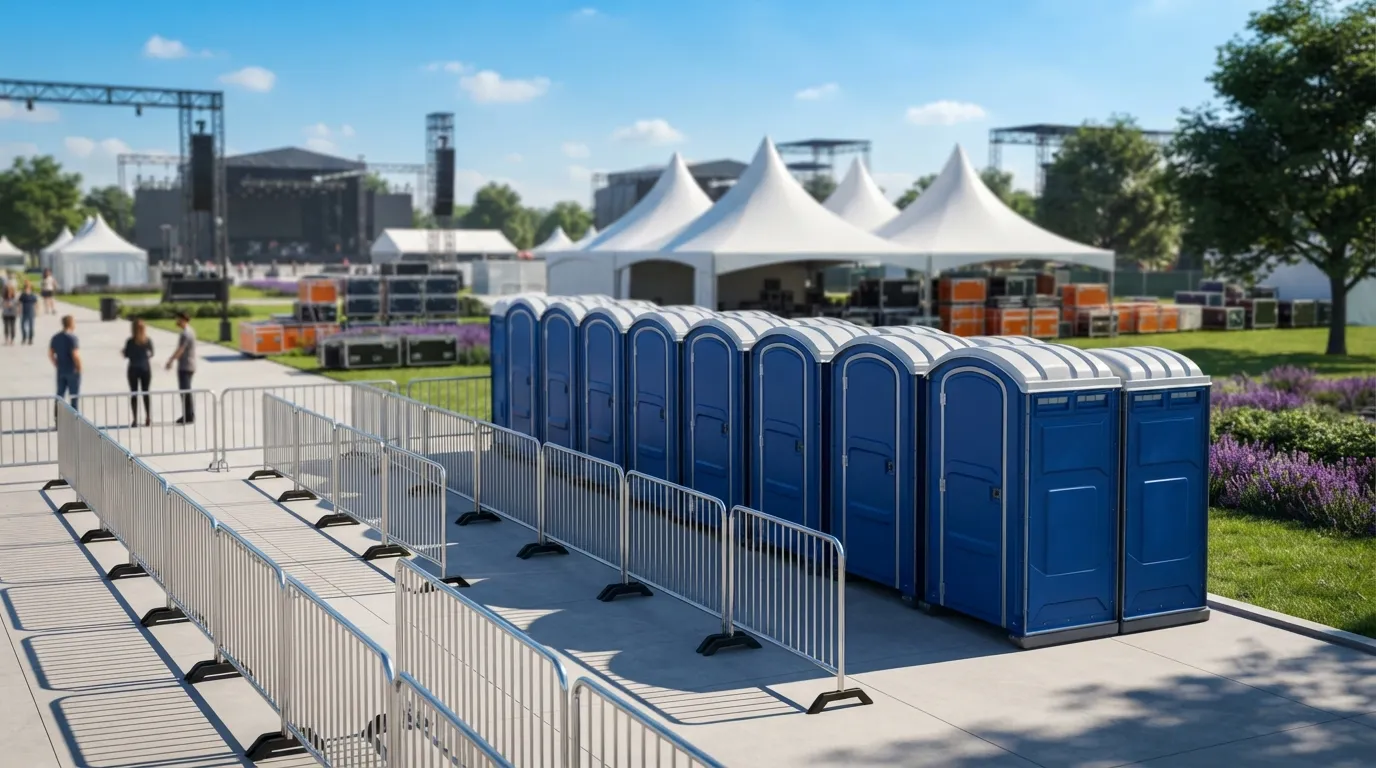
Yes, once you're clustering units. ADA Standards section 213.2 requires that where portable toilets are grouped together, at least 5 percent of the cluster must be accessible, with a minimum of one unit regardless of total count. That accessible unit needs a 32 inch clear door opening under section 404.2.3, a 60 inch turning circle inside under section 304.3.1, and a stable, slip-resistant floor per section 302.1. Reach ranges for dispensers and locks fall under section 308.2.1, and hardware has to operate one-handed with no more than 5 pounds of force under section 309.4. Our ADA accessible porta potty page has full specs. Public events in Rialto with foot traffic from families or older attendees should plan for this from the start, not as an add-on after the layout is set. Check ADA restroom requirements if you're staging a multi-unit bank for a fair, festival or race.
What About Handwashing and Water Requirements?
General jobsite sanitation does not force handwashing stations everywhere, but two rules matter. OSHA 1926.51(a)(1) requires potable water on site. OSHA 1926.51(f)(1) requires washing facilities specifically where workers apply paints, coatings, herbicides or insecticides, or handle other contaminants, so a painting subcontractor or a landscaping crew spraying herbicide triggers this even if the general trades on the same site don't. 29 CFR 1910.141(d)(2) requires soap and towels or a hand-drying device at washing stations, and hand sanitizer alone does not satisfy that rule. Our handwashing station rental and portable sink rental pages break down unit options, and handwashing requirements goes deeper into which trades trigger the rule. ANSI/PSAI Z4.3 sets a baseline service interval of one visit per week for up to 10 users across a 40 hour week, which is the starting point we use for how often are porta potties cleaned planning before adjusting for actual headcount.
| unit | day | week | month |
|---|---|---|---|
| standard | $100 - $350 | $130 - $500 | $125 - $325 |
| ada | $200 - $400 | $240 - $400 | - |
| deluxe | $85 - $1200 | $150 - $290 | - |
Pricing depends on unit type, rental length and delivery distance. Full breakdowns live on porta potty rental cost, porta potty rental per day and monthly porta potty rental. If your job runs near Muscoy, about 6.0 miles northeast of Rialto, delivery fees still apply the same way.
Does Cal/OSHA have different portable toilet rules than federal OSHA?
Cal/OSHA generally mirrors the federal construction ratio in OSHA 1926.51(c)(1). There is no separate published Cal/OSHA toilet-count table in wide use that changes those numbers for construction crews. When in doubt, size to the federal ratio and confirm with your safety officer before the crew mobilizes.
How many porta potties do I need for a 30-person crew?
Under OSHA 1926.51(c)(1), a 30-person crew falls in the 20-to-199 bracket, needing one toilet seat and one urinal per 40 workers. In practice that means one combo unit is often enough at 30 people, though many contractors add a second for turnover speed during breaks.
Do OSHA rules apply to storage containers or dumpsters on site?
No. OSHA 1926.51(c)(1) covers sanitation facilities specifically. Storage containers and dumpsters fall under different site safety and housekeeping rules, like OSHA 1926.25. We handle both portable toilet rental oshawa style crews and storage container rental oshawa style crews often ask about under one job, so see storage container rental and dumpster weight limits for those separate requirements.
What happens if a Rialto job site doesn't meet OSHA toilet ratios?
An inspector can cite the contractor, and the crew may face delays until units are added. It's cheaper to order correctly from the start. Our emergency porta potty rental service covers last-minute additions if a headcount changes mid-project.
Are handwashing stations required at every construction site?
Not universally. OSHA 1926.51(a)(1) requires potable water everywhere, but the specific washing-facility trigger under OSHA 1926.51(f)(1) applies only where paints, coatings, herbicides, insecticides or similar contaminants are in use on that site.
Next step
Get a delivery date
Tell us the address, the dates and the headcount. We size the order and confirm the route.